Usual Disclaimer; this is MY interpretation of Teton County’s new code. You can find a complete version of the code HERE. Information should always be confirmed with Teton County, Idaho.
As outlined in the first part of my series breaking down the 2022 code, there are 7 zoning types in the unincorporated areas of Teton County, Idaho. Below is a breakdown with differences in each. This does not include the City Limits of Driggs, Victor or Tetonia, or their respective areas of impact.
AREAS OF IMPACT
The Areas of Impact around each city constitute their own zoning districts. However, they are under the jurisdiction of Teton County. Land use and regulations in these areas may be negotiated with each respective city. These are areas of potential annexation into the cities. Although these areas are identified on the new zoning map, we have yet to see details and negotiations between the county and city in these areas. For now, we’ll leave this for another discussion.
AVERAGE DENSITY REFRESHER
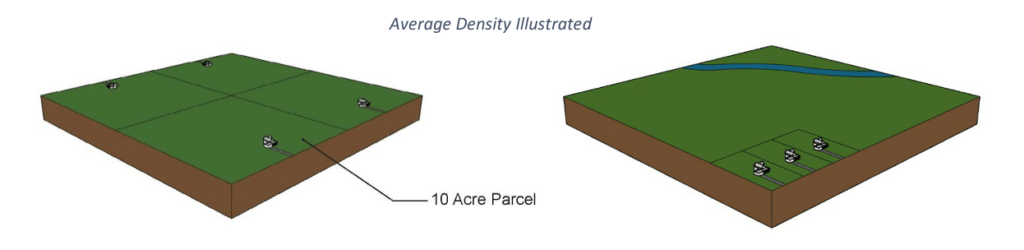
As I work through each of the 7 new zones, I’m going to be referring to average density. Remember, this is something (essentially terminology) that the county is pushing as opposed to minimum lot sizes. Essentially, if you had a 40 acre parcel in a 10 acre zone, you could either have four 10 acre parcels, or you could have a cluster of smaller parcels and a larger parcel. In other words, just because you are in a 10 acres zone does not mean that you are required to have 10 acre parcels. In fact, every new zone in the county has a 1 acre minimum lot size. This is all in reference to subdividing land, and we’ll get into that more in another article.
NOTE ABOUT CC&Rs: As I describe the County requirements in each zone, remember that this is a county regulation, not necessarily a subdivision regulation. If you are in a zone with a 30 ft Building height limitation and you are in a subdivision with a 24-foot height limitation, you are still limited to the 24 ft per the subdivision covenants and restrictions.
REFERENCE: The use table for each zone located on page 22 of the Land Development Code.
BREAKING DOWN EACH ZONE
IR, INDUSTRIAL RESEARCH
Minimum lot size: 1 Acre
Minimum lot width: 70′
Minimum front and side setbacks: 10′
Minimum rear setback: 10′
Maximum Building height: 45′ (60′ for agricultural buildings)
Average density requirement: None
Teton County’s description: The Industrial/Research (IR) Zone is intended to accommodate manufacturing, light industrial, office, and research uses with limited accessory residential uses. Most of these areas have low visibility from the highways and tourist centers and are currently undeveloped with some utility services available. Accessory retail and wholesale commercial uses are allowed in the IR Zone, as well as higher impact manufacturing and industrial uses with buffering and other impact mitigating measures as defined in Chapter 3, Use Provisions.
Tayson’s Comments: The industrial research zone is fairly straightforward. Uses like vehicle service and repair and warehouse storage are obviously permitted. Uses that are not permitted include cemeteries, lodges, hospitals, places of worship, a bed and breakfast, daycare, equestrian centers or special event facilities.
An accessory dwelling unit (ADU) that is attached to the main structure is allowed with some limitations, this is an important element to remember when researching something in the industrial zone. Because both main industrial zones are already in subdivisions in Teton County, keep in mind that you would need to review the covenants and restrictions for each development in addition to the standards. Teton county’s definition in section 3-9-2 for an attached accessory dwelling unit states that only one hey do you is allowed per parcel, two parking spaces shall be provided, there’s a maximum size of 1,500 ft and the applicant must provide verification of wastewater treatment.
I’ll get into short-term rentals in another section of the code breakdown, but short-term rentals are not allowed in the industrial zone whereas they are allowed in every other zone in Teton County.
RN-5, RURAL NEIGHBORHOOD
Minimum lot size: 1 Acre
Minimum lot width: 100′
Minimum front and side setbacks: 30′
Minimum rear setback: 40′
Maximum Building height: 30′ (60′ for agricultural buildings)
Average density requirement: 5 Acres (avg density)
Teton County’s description: The Rural Neighborhood (RN-5) Zone is intended to accommodate primarily residential uses at an average density not exceeding one (1) lot per five (5) acres. RN-5 serves as a transitional zone between the Areas of City Impact and rural areas. This zone is intended to serve as a receiving area in a potential Transfer of Development Rights program wherein gross density of one (1) lot per two and a half (2.5) acres would be allowed with the appropriate density credits. Projects in the RN-5 Zone that propose clustered development shall identify areas within the project that are designated as unbuildable open space. The priorities for open space in the RN-5 District include riparian areas, significant areas of native vegetation, important wildlife habitat, and areas for community parks.
Tayson’s Interpretation: The Rural Neighborhood zone offers the highest available density in the unincorporated areas of Teton County with an average maximum density of 5 Acres. Obviously primary dwelling units, outbuildings, attached or detached accessory dwelling units are allowed in this zone as well as home businesses with other conditional uses are also considered.
FH-10, FOOTHILLS
Minimum lot size: 1 Acre
Minimum lot width: 100′
Minimum front and side setbacks: 30′
Minimum rear setback: 40′
Maximum Building height: 30′ (60′ for agricultural buildings)
Average density requirement: 10 Acres (avg density)
Teton County’s description: The Foothills (FH-10) Zone District is intended to ensure development is in harmony with mountainous and hilly settings that are at higher risk to wildfire and notable for wildlife values. FH-10 serves to provide limited residential development with an average density not to exceed one (1) lot per ten (10) acres in the foothills of the Western, Southern, and lower elevation Northeastern portions of the valley. The intent for development in the FH10 is to maintain public access to state and federal lands; discourage scattered hillside development that requires remote roads and infrastructure; follow best practices to help prevent wildfires and minimize threats to life and property when wildfires do occur in the fire prone wildland interface; protect steep slopes; and preserve critical wildlife habitats such as wildlife migration linkage areas at the forest edge, and to protect native vegetation and scenic views of the foothills from the valley floor.
Tayson’s Interpretation: As apparent in the description, the Foothills section was created with wildlife and wildfires in mind to minimize threats in these wooded areas. Here again, obviously, a primary dwelling unit is allowed as well as an attached ADU, with limited use available for a detached ADU. The two Foothills zones are the only zones aside from the industrial zone where detached guest houses are not expressly permitted. The used table does provide for a limited use with respect to detached guest houses which requires planning administrator approval subject to specific use and dimensional standards.
FH-20, FOOTHILLS PRIORITY PROTECTION
Minimum lot size: 1 Acre
Minimum lot width: 100′
Minimum front and side setbacks: 30′
Minimum rear setback: 40′
Maximum Building height: 30′ (60′ for agricultural buildings)
Average density requirement: 20 Acres (avg density)
Teton County’s description: The Foothills Priority Protection (FH-20) Zone District is intended to ensure development is in harmony with mountainous and hilly settings that are at higher risk to wildfire and are of high priority for protection of known wildlife values. FH-20 serves to provide limited residential development with an average density not to exceed one (1) lot per twenty (20) acres in the higher elevation foothills of the Northeastern portion of the valley. The intent for development in the FH-20 is to maintain public access to state and federal lands; discourage scattered hillside development that requires remote roads and infrastructure; follow best practices to help prevent wildfires and minimize threats to life and property when wildfires do occur in the fire prone wildland interface; protect steep slopes; and preserve critical wildlife habitats such as wildlife migration linkage areas at the forest edge, and to protect native vegetation and scenic views of the foothills from the valley floor.
Tayson’s Interpretation: The Foothills priority protection zone is more or less the same as the Foothills zone with a few slight changes. The primary difference is obviously the density with a 20 acre minimum average density as opposed to 10 in the Foothills zone, but there are some considerations for access to public lands, and the use table provides for a few small differences including no limited use for an agricultural auction facility, no limited use for a garden center, more use options for a dude ranch, no special use consideration for vehicle service and repair, and no allowance for any form of wireless communication tower. The same rules apply with respect to detached ADUs and this zone with a limitation on use and a requirement for Planning Administrator approval.
RR-20, RURAL RESIDENTIAL
Minimum lot size: 1 Acre
Minimum lot width: 100′
Minimum front and side setbacks: 30′
Minimum rear setback: 40′
Maximum Building height: 30′ (60′ for agricultural buildings)
Average density requirement: 20 Acres (avg density)
Teton County’s description: The Rural Residential Zone (known as Mixed Agriculture/Rural Neighborhood in the comprehensive plan) is established to allow residential development with an average density not to exceed one (1) lot per twenty (20) acres near the incorporated areas while maintaining the rural atmosphere of Teton County. RR-20 serves to provide a place in the County where residential dwellings may be interspersed with agricultural uses and provide opportunities for residents to have gardens, farm animals, and livestock. The intent of the RR-20 is to keep land in agricultural production, preserve open space, and protect native vegetation, riparian areas, and critical wildlife habitat.
Tayson’s Interpretation: The rural residential zone is essentially an in-between zone from the rural neighborhood to the rural agriculture zones with very similar use requirements. In addition to your primary residence, detached ADUs or guest houses are permitted.
RA-35, RURAL AGRICULTURE
Minimum lot size: 1 Acre
Minimum lot width: 100′
Minimum front and side setbacks: 30′
Minimum rear setback: 40′
Maximum Building height: 30′ (60′ for agricultural buildings)
Average density requirement: 35 Acres (avg density)
Teton County’s description: The Rural Agriculture (RA-35) Zone is established to provide areas primarily used for agricultural purposes and very low density residential with an average density not to exceed one (1) lot per thirty-five (35) acres. The intent of RA-35 zoning is to provide locations for the cultivation of crops, the raising and keeping of livestock, and other related agricultural uses. The RA-35 zone district also serves to nurture wildlife habitats and preserve the beauty of the rural agricultural lands in Teton County by utilizing clustered development designs. It also provides the opportunity to use average residential density to establish smaller residential lots for family use or development while preserving agricultural lands.
Tayson’s Interpretation: The real agricultural zone is somewhat self-explanatory. It has a minimum density requirement of 35 Acres with the intent to leave room for agriculture, raising livestock, etc. The county would like to promote clustered residential areas in this zone to keep these wide open spaces… wide open.
The uses in this zone are fairly broad with limitations on some items that you find available in the rural neighborhood zones such as vehicle and equipment sales with a limited use option, but with more allowable uses that might conform to larger spaces such as consideration for an outdoor University, permitted uses for a riding academy/equestrian center, etc. Both attached and detached ADUs are allowed.
LA-35, LOWLAND AGRICULTURE
Minimum lot size: 1 Acre
Minimum lot width: 100′
Minimum front and side setbacks: 30′
Minimum rear setback: 40′
Maximum Building height: 30′ (60′ for agricultural buildings)
Average density requirement: 35 Acres (avg density)
Teton County’s description: The Lowland Agriculture (LA-35) zone district (known as Mixed Agriculture/Wetland in the comprehensive plan) allows an average density not to exceed one (1) lot per thirty-five (35) acres. It includes areas where development may be limited due to the remoteness of services, topography, jurisdictional wetlands, floodplains, and other sensitive environmental issues. These areas have seasonally important wildlife resources, are predominately rangeland and agriculture land, and have high scenic qualities. The intent of the LA-35 zone is to maintain undeveloped floodplains, protect homes from the risk of flooding, protect water quality from the impacts of development, and protect native vegetation and critical wildlife habitat.
Tayson’s Interpretation: The lowland agricultural zone is more or less similar to the rural agricultural zone with a few limitations that make sense to protect wildlife and other considerations in these areas. An example might include a limitation on employee housing in this zone, that is allowed with a special use approval in the rural agricultural zone. Here again, both attached and detached ADUs are allowed.