Teton Realty Blog

Teton Region Real Estate Market Stats, Articles & News

  • Home
  • Listings ‘N Stuff
    • Property Search
    • Search Account
  • The Blog
    • Buyers
    • Sellers
    • Local Info
    • Market Reports
    • Know Your Home
    • 2022 Teton County, ID Code
    • Pages & Categories
  • About/Contact Me
    • Contact Me
    • About Me
    • Testimonials
  • Log In/Subscribe
    • Account Set-Up/Log-In
    • Weekly Newsletter
  • Facebook
  • LinkedIn
  • YouTube

The Short List: Teton Valley Gear That’s Earned My Trust

January 6, 2026 By Tayson Rockefeller Leave a Comment

I’ve thought for years about writing short, honest recommendations for products that work well in the mountains, specifically Teton Valley. I’ve waited long enough to write this that a couple things I used to endorse are now basically obsolete (I’m dating myself here, but I’m still in my 30s), and I’ve also changed my mind on a few others. Some of these recommendations I might regret later, but a few have really stood the test of time.

Before I begin, two quick notes from the past:

  • Outdated: Utility monitoring gadgets: I once endorsed an electric meter sensing device that monitored usage, but many utility providers now do this natively, so it’s become dated.
  • Flip Flop: Mini-splits: Great for retrofits, but on new builds, I definitely prefer forced air or in-floor heat paired with air conditioning.

Okay, here it goes:

1) YoLink

YoLink (I believe the parent company is YoSmart) offers smart devices to monitor things like humidity, temperature, and moisture. For second homeowners, this type of monitoring is a must. It doesn’t replace boots on the ground (more on that later), but it does give you a 24/7 guard with notifications.

I used to recommend the Moen Flo home alert devices (not the plumbing shutoff stuff), but I found the batteries were expensive, didn’t last long, and the range was limited to Wi-Fi. YoLink devices sync to a hub that sends a long-range signal to each device, which is a big deal.

They’ve got leak sensors, temperature and humidity sensors, power-out notifications, and even a freezer sensor that could save a deep freeze. I won’t say they’re perfect (the hubs still use micro-USB… we need to get into the 21st century there) but overall they’ve been solid.

2) Bridgestone Blizzak tires

I get asked all the time: “Do you really need Winter tires?” My answer is yes. Yes, you do.

“What about all-season tires? They’re rated for snow!” No, not like you think. Getting to my garage during Winter conditions can be a rodeo, and there are days it’s simply not possible without true Winter tires. But it’s not just about whether you can go, it’s stopping power, acceleration when you need it, even pulling out from a stop sign. The difference is incredible.

Most Winter tires are pretty good, and in my opinion you usually don’t need studs. I’ve owned a lot of sets, and if you can find them, Blizzaks are the best.

3) Honda snowblowers

I don’t want to get carried away about Winter here, but it is something we deal with. If you’re insistent on removing your own snow (again, more on that below), you should consider a snowblower. And if you’re considering a snowblower, you should really only consider a Honda.

Yes, they cost more. However, the reliability is incredible. I remember my first experience with a Honda snowblower back in my property management days. An old model was left out on a hillside (why anyone would leave a Honda snowblower out on a hillside is beyond me, but I digress). While scratching my head trying to figure out how I’d drag it off the hill and load it in my truck, it occurred to me I could try to start it…

First pull. The rest is history.

4) Boots-on-the-ground support (Home Watch / inspections / management)

This isn’t a pitch for our management division (ahem… Teton Valley Property Management). It’s just the reality of mountain ownership: the biggest issues tend to get expensive when nobody catches them early. I’m not challenging what someone can do themselves, I’m challenging what can realistically be done remotely.

If you’re an absentee owner, I strongly encourage regular property inspections, a home watch service, or some form of boots-on-the-ground support, even if it’s just periodic check-ins. If you want a starting point for what that can look like, TetonValleyHomeWatch.com is a local resource (and not my company) that outlines the general idea and scope of home watch services.

Wildlife Analyses in Teton County’s Overlay Zones

July 27, 2025 By Tayson Rockefeller Leave a Comment

Let’s talk about the Teton County, Idaho (unincorporated areas of the county) National Resource Overlay, and specifically, drill down on the required Wildlife Analyses.

Before we do, I’ll point out that the Natural Resource Overlay has been amended multiple times, most recently in 2025. This is a highly controversial topic, probably more so than any other issue with Teton County’s 2022 Land Development code second only to zoning changes themselves in my opinion. That being said, feel free to use this article to understand these overlays and policies as I do, but at the same token, take this as a grain of salt. I have made clear assumptions with respect to these policies based on the available data to find out that I was not aligned with the County Planning department. Always verify information with local authorities.

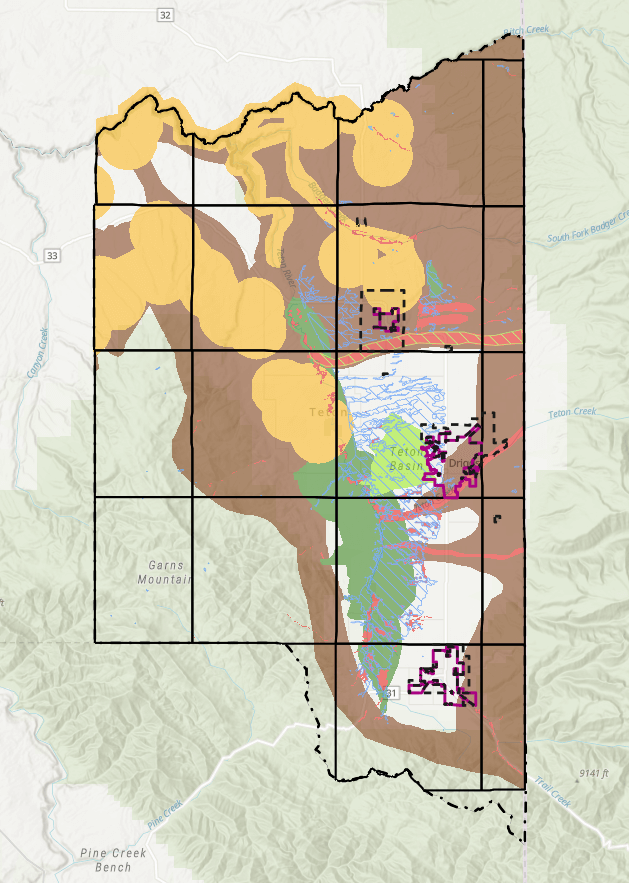
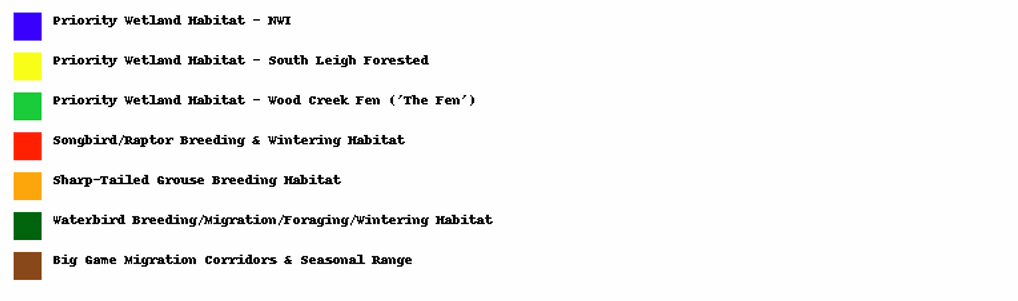
So, briefly, what is the Natural Resource Overlay? This is a mapped overlay adopted by Teton County to identify areas that are sensitive to wildlife and habitat. As I understand it, this data was gathered in conjunction with the Idaho Department of Fish and Game in 2022 as well as local experts and authorities. There are several overlays throughout the county identified below, I also created a map legend to help identify each.

A quick note on Wetland areas:

I won’t go into too much detail relative to Wetland habitat areas including the main overlay, the South Leigh forested areas or the Wood Creek Fen areas. These areas not only trigger Wildlife considerations, but also Wetland specific review. My understanding is that the South Lee forested wetlands in the Woodcreek Bend are locally defined priority Wetlands not always visible in the federal data sets like the NWI, but they are treated similarly and may still require Wetland delineations or other studies. I have other articles where I dive into Wetland, so for now, we’ll focus on the remaining Wildlife overlays.

What is a WHA vs an A-AWA?

Wildlife Habitat Analysis (WHA)

I would consider a WHA as intended to be a more specific, detailed analysis of a given property for specific reasons, primarily Subdivision / Land division and Special Use Permit or Conditional Use Permit situations. These are extensive studies to look at the viability of a subdivision of land that meets all other requirements and eligibility for subdivision in the county. They might look at placement of building envelopes or parcel sizes as they pertain to proximity to sensitive areas or how they might impact sensitive areas. Similarly, special or conditional permits may require these more calculated, advanced studies. They typically include detailed field work, mapping, species analysis and an overall conservation plan. They must be prepared by a pre-qualified consultant according to the County’s data set (applicants that are not pre-qualified can apply) and are reviewed by planning staff before moving to concept plan stages. They take into account cumulative landscape impacts, Wildlife corridors, and conservation ratios.

Abbreviated Wildlife Habitat Analysis (A-WHA)

Abbreviated analyzes are required for building permits within the nro, are short form by comparison, and are approved by the Planning and Building Department before building permit approval. They focus on site level planning and proximity to known habitat or sensitive features and are intended to be streamlined for homeowners and small-scale projects, however, they are still currently required to be performed by Consultants that are approved by the county. Here again, applicants that are not pre-qualified, can apply.

What Triggers the Requirement for an Analysis?

Essentially, any parcel with identified indicator habitat species, mapped Wetland or riparian zones, and most easily identified, Parcels that are located inside one of the Natural Resource Overlays. HOWEVER, there are situations when properties can be exempt from these requirements:

The parcel containing the proposed project is exempt from the need for a
WHA or A-WHA if one or more of the following conditions applies:
– The parcel is located completely outside the boundaries of the NRO.
– The parcel is partially within the NRO but the proposed project site on
the parcel is at least 100 feet outside of the boundaries of the NRO
(this condition applies for building permit requests only).
– The parcel has previously undergone a county-approved natural
resource analysis (WHA or other).
– The parcel is under a conservation easement from an organization
accredited by the Land Trust Alliance and the building envelope has
already been identified in the recorded documents.
– The parcel is in a pre-existing platted neighborhood/subdivision and
is < 3 acre in size.
– The project is in an existing building envelope on the parcel.
– The project is for additional development fully contained within 50 feet
of existing development on the parcel.

In addition, The parcel is exempt from the need for a WHA or A-WHA if all three of the

following conditions apply:
– The parcel is in a pre-existing platted neighborhood/subdivision and
is > 3 acres and < 5 acres in size.
– The parcel is covered only by the “Big Game Migration Corridor &
Seasonal Range” layer of the NRO.
– The parcel has no USGS-designated perennial, seasonal or
intermittent stream courses present.

Breaking that down, the most likely scenario are properties that are in existing platted subdivisions and are less than 3 acres in size. Additionally, if the project is inside an existing building envelope, that could easily mitigate the requirement for one of these analyzes. Remodels should also be protected if the additional development is fully contained within 50 ft of existing development on the parcel. We do our best to provide resources that include approved contractors for these types of analysis on our brokerage website, make sure to make an account with one of our agents, and again, always confirm this information.

Are Public Lands Guaranteed?

July 1, 2025 By Tayson Rockefeller Leave a Comment

I have always been an advocate for providing clear information, but never guarantees. I always lead opinions with a pretty clear statement that “my opinion is”… That being said, one of the assurances none of us ever expected to change was public lands and how they can create open space for properties that are adjacent.

While adjacent public land or public land access is generally viewed as a major selling point or benefit (even in the absence of what I’m about to dig into), it can also have its downsides. For example, living near an access or trailhead could create an increase in motorized or non-motorized traffic which could lead to privacy or sound concerns. Notwithstanding, I generally feel that these types of annoyances are limited compared with the broader scope of being fortunate enough to live next to these recreation access points.

Though we have always assumed these lands would remain public in perpetuity, we recently witnessed a quiet, but far reaching proposal on the Federal level come into the spotlight that might change how we think about public lands moving forward. Tucked into a sweeping budget reconciliation bill AKA the “One Big Beautiful Bill” or (OBBBA) was language that may have required the US Forest Service and Bureau of Land Management to offer millions of acres of federal land for sale, much of which was adjacent to private property, particularly in the Teton Valley.

Fortunately, this section of the bill was met with massive opposition from conservation groups, outdoor Advocates, and private citizens. As a result, the land sale Provisions have since been removed from the Senate bill. At the time of this writing, there is no mandate to sell public land, at least as I interpret it. However, there are still some concerning aspects in the broader bill. They include Provisions that could affect land use and access including logging, oil and gas leases and reduced environmental oversight. In addition, just because this aspect of the bill was modified and removed, does not mean that it could resurface in the future.

All of this is a good reflection point for those of us in the real estate industry, or those that are interested in real estate or own real estate near public lands. Buyers will continue to be drawn to properties that border national forest or BLM because of the perceived open space permanence. We view it as an unbuildable buffer, unlimited open space and boundless Recreation opportunities. It’s important, however, to know that federal land boundaries can shift. BLM parcels, in particular, can be swapped, sold or least. While I view National Forest as much more immune to change, nothing is a guarantee, in my eyes as mentioned above. While unlikely, I think it’s something to reflect on. For those interested in real estate, we always recommend:

– Review designations such as Wilderness, National Forest, BLM, etc.

– Verify access, types of access, permitted juices and any known planning actions by contacting County officials and public land agencies

– Understand that public land status is subject to policy and political change

Public land is one of our Region’s greatest assets. For now, fortunately, the effort to sell it off has been stopped. Whether you are a buyer, landowner or simply a neighbor to these great assets, it’s worth remembering, things can change. Stewardship starts with staying informed, and advocating for our region’s great assets.

Floodplain, who’s in charge, and what does it mean?

May 2, 2025 By Tayson Rockefeller Leave a Comment

For some reason, of all the “layers” encompassing lands throughout Teton Valley (or anywhere else), floodplain has always been the most difficult for me to understand. Merriam-Webster defines floodplain as “level land that may be submerged by floodwaters, or a plain built up by stream deposition.” To me, floodplain isn’t necessarily always flat, but it isn’t the definition that I struggle with. It more has to do with what it means for those that have floodplains indicated on their property.

Before I go any further here, and with my preface out of the way, I STILL struggle with floodplain. With that—and all articles I have written over the years—take this with a grain of salt. These are my interpretations about complex issues, and I have no authority on these matters. Always do your own research through proper authoritative agencies.

Tayson’s definition of floodplain, and the purpose of having this information:

I don’t think anybody’s really struggling with the definition here, but to expand: Floodplain, as I understand it, is determined through elevation (obviously the low-lying areas are going to accumulate water), hydrology (how water moves), and soil types. For example, in a past article I talked about attending a FEMA open house at the Teton County Courthouse, which detailed how this data is collected and how the County is working with FEMA to update its flood maps. As of this writing, the appeal period for those wishing to contest the proposed maps is closing, paving the way for final approval of the new, more accurate flood zones and associated maps.

The purpose of having this data:

To me, the greatest benefit of having this information is to mitigate risk. In a real-life scenario, I don’t think that Merriam-Webster’s definition works to describe potential areas of risk. Since water moves in precarious ways, we can hope to rely on science and data to give us that clearer picture of areas of risk. This can then be used for landowners to plan new projects or mitigate risk with existing structures. It’s also used by insurance companies—particularly those participating in the National Flood Insurance Program—to assess flood risk and determine insurance requirements. As I understand it, the NFIP is a federal program managed by FEMA that provides flood insurance to property owners, renters, and businesses, and it relies heavily on FEMA’s floodplain maps to assess risk and set insurance rates.

How the data is obtained and displayed:

Again, no expert here, but I do know that the latest information available was provided through LiDAR flyovers to gather contours and terrain, as well as hydrologic and soil studies to model how water moves and flows. Because of the level of technology, these maps can display not only areas of concern but also different levels of risk in certain areas. Historically, my understanding was that the primary defined areas of risk included 100-year and 500-year flood risk areas. I also understand that new efforts are being made to display this risk through percentages as opposed to yearly events, so as not to confuse the intended definition of that risk.

As an example, a property in a 500-year flood risk area does not necessarily mean it will only flood once every 500 years. Describing that same risk as a 0.2% annual chance of flooding conveys the same statistical probability, but in a way that more clearly communicates the level of risk. Similarly, a 100-year flood event area might also be described as having a 1% annual chance of flooding. Because of the advanced technology used to gather this new data, additional flood risk areas can also be defined—but it’s important to remember that these are estimates based on modeling. Obviously, anything can happen.

Who creates the maps?

The maps themselves are generally created through FEMA (Federal Emergency Management Agency) in cooperation with the National Flood Insurance Program (NFIP) and local jurisdictions. FEMA contracts with engineering firms and works with local governments to ensure maps reflect both scientific modeling and local conditions. These are the same maps used for regulating development in flood-prone areas and determining flood insurance requirements.

Can the information be challenged?

As advanced as this data might be, it is broadly used across great areas of landscape. As a result, property owners or developers may have the opportunity to challenge this data through site-specific engineering to determine the exact elevation of a structure relative to the projected floodwaters. This is typically done through an elevation study, which can then be used to produce an Elevation Certificate. While this certificate is often required for determining compliance with building standards or securing flood insurance, it can also be submitted to FEMA to support a request to remove a structure from a mapped high-risk zone.

In some cases, more formal map changes are needed. A Letter of Map Amendment (LOMA) can be requested when a property owner believes their structure or lot was incorrectly included in a flood zone. These are often supported by Elevation Certificates and typically apply to individual lots or structures. For larger-scale changes—such as those affecting an entire development or subdivision—a Letter of Map Revision (LOMR) may be appropriate. These tools can be essential for developers and landowners when building or remodeling near designated floodplains.

What is the County’s role?

In the event that there is development in a floodplain, the County’s policy (as I interpreted during a meeting with the County on the subject) was for structures to be a minimum of one foot above freeboard.

In that meeting, they referred to something called “freeboard,” which, as it turns out, is a nautical term. In boating, freeboard is the distance between the waterline and the edge of the boat—basically the buffer that keeps water from spilling in. In the floodplain world, it’s a similar idea. Freeboard refers to the extra height that structures need to be built above the projected flood level. It gives a bit of wiggle room for things like model inaccuracies or bigger-than-expected storms. In Teton County, that buffer is currently set at one foot above the base flood elevation for any development in a flood zone, though which zone this applies to should be clarified prior to any construction.

Additionally, the representative in the meeting stated that the County does maintain some generic latitude, which might include looking at developable areas on a building site that may not be in the floodplain. There are also considerations when it comes to vegetation removal in instances of development in or around a floodplain, understanding that removing vegetation can also impact these waterways. Because I have not been able to point to any specific area of the code to identify the County’s requirements in addition to those set forth or recommended by FEMA, it is important to remember to consult with industry professionals and engineers, and to work directly with the planning and zoning and/or building departments to understand what’s allowed, and what’s required.

  • 1
  • 2
  • 3
  • …
  • 30
  • Next Page »

Recent Testimonials

  • Douglas V.
  • Chuck M.
  • Terry & Joy K.
Teton Valley Realty
Copyright Teton Realty Blog© 2026 - Tayson Rockefeller - [email protected] - 208-709-1333 - sitemap | Privacy Policy, Copyright & Terms of Use