Teton Realty Blog

Teton Region Real Estate Market Stats, Articles & News

  • Home
  • Listings ‘N Stuff
    • Property Search
    • Search Account
  • The Blog
    • Buyers
    • Sellers
    • Local Info
    • Market Reports
    • Know Your Home
    • 2022 Teton County, ID Code
    • Pages & Categories
  • About/Contact Me
    • Contact Me
    • About Me
    • Testimonials
  • Log In/Subscribe
    • Account Set-Up/Log-In
    • Weekly Newsletter
  • Facebook
  • LinkedIn
  • YouTube

Property Assessments, Are Taxes Going Through the Roof?

June 14, 2022 By Tayson Rockefeller Leave a Comment

Unless you were living under a rock for the past 2 years (which might have been nice) you probably know that property values are up significantly. Until now, we haven’t seen County assessed values follow suit. With the recent release of 2022 assessed values, many are concerned that property tax increases are soon to follow. However, this doesn’t necessarily mean that your tax bill is going to go up proportionately.


In Idaho, each county is allowed to increase its property tax budget by up to 3% of the highest property tax budget of the past 3 years. The county can also increase their budget to account for new growth.


In order to calculate the tax rate, each taxing district within the county (Teton County has 18 taxing districts that each have slightly different budgets and needs) determines a levy, or the rate of which the county will multiply the assessed value to determine each property’s annual tax bill.


As an example, let’s say that district 1 has a total budget of $900k. In 2021, the total market value of every property in district 1 is $70m. To determine the levy, we would simply divide 900k by 70m, or 1.287%. If your assessed value is $300k, we simply multiply that by 1.287% to arrive at your 2021 tax amount of $3,861.


Now, let’s run a hypothetical based on what we are seeing today. We know that the total budget is going to increase with the new growth and the state’s allowance to increase the budget by up to 3% (ahem, inflation). Let’s assume that the new budget is $990k, and the collective value of all properties has risen to a whopping $110m. Using the same math, we divide $990k by $110m and arrive at 0.9%. Your value went from $300k to $450 this year. The math puts your 2022 tax bill at $4,050. While your tax bill has risen, it hasn’t risen 150% like your assessed value has.

The good news? Property values are up, and I know an agent that would love to sell your house.

Key Dates:

  • Mid-November – Current year tax bills mailed
  • December 20th – FIRST HALF TAX PAYMENT DUE
  • March 15th – Agricultural Exemption Applications Due
  • April 15th – Application deadline for Hardship Tax Relief or Circuit Breaker Program
  • April 15th – Application deadline for Homeowner’s Exemption
  • June 20th – SECOND HALF TAX PAYMENT DUE
  • First Monday in June – Assessment notices sent out
  • Last Monday in June – Last day to appeal current year’s property values
  • Summer – County begins planning budget for following year
  • Second Monday in September – County certifies budget
Application for Agricultural Exemption

Agricultural Lease Agreement

Interest Rates, Ideas for Buyers and Market Impacts

May 6, 2022 By Tayson Rockefeller Leave a Comment

It’s no secret, interest rates are definitely on the rise, and likely will continue to do so. It’s interesting hearing about all of the potential impacts. A lender friend of mine provided some good insight recently. Interest rates are still very low from a historical standpoint, and there are still some great ways to minimize the impacts of rising rates. These include mortgage points that come with a variety of options and the ability to have these points negotiated into a transaction or even paid by the seller. A mortgage point is effectively a way to buy down the interest rate up front. This can be a great tool to help buyers keep up with today’s real estate prices, which don’t seem to be going down despite interest rates creeping up. Buying mortgage points can also work well for buyers that intend to keep their loans long-term. Typically a “point” is equivalent to 1% of the purchase price and that will usually reduce the interest rate anywhere from 1/8 to 3/8 of a percent. Other options include a 2-1 (or even a 3-2-1) buy down which reduces the first year by 2 points in the second year by one point, which is where the highest amount of interest is paid on a loan while the principal of balance is still high.

Obviously interest increases are coming as a way to combat inflation, and it’s probably the lesser of two evils. Interestingly, supply chain issues, high building costs and other factors on the supply side are keeping new inventory at bay. Whereas real estate is primarily supply and demand based, this has created an interesting dynamic for both buyers and sellers. Personally, I do believe that the cumulative total of these issues will have an impact on the market, but without the increase of supply, I’m interested to see how much (if any, I should add).

2021 Residential Year End Sales Report

February 16, 2022 By Tayson Rockefeller Leave a Comment

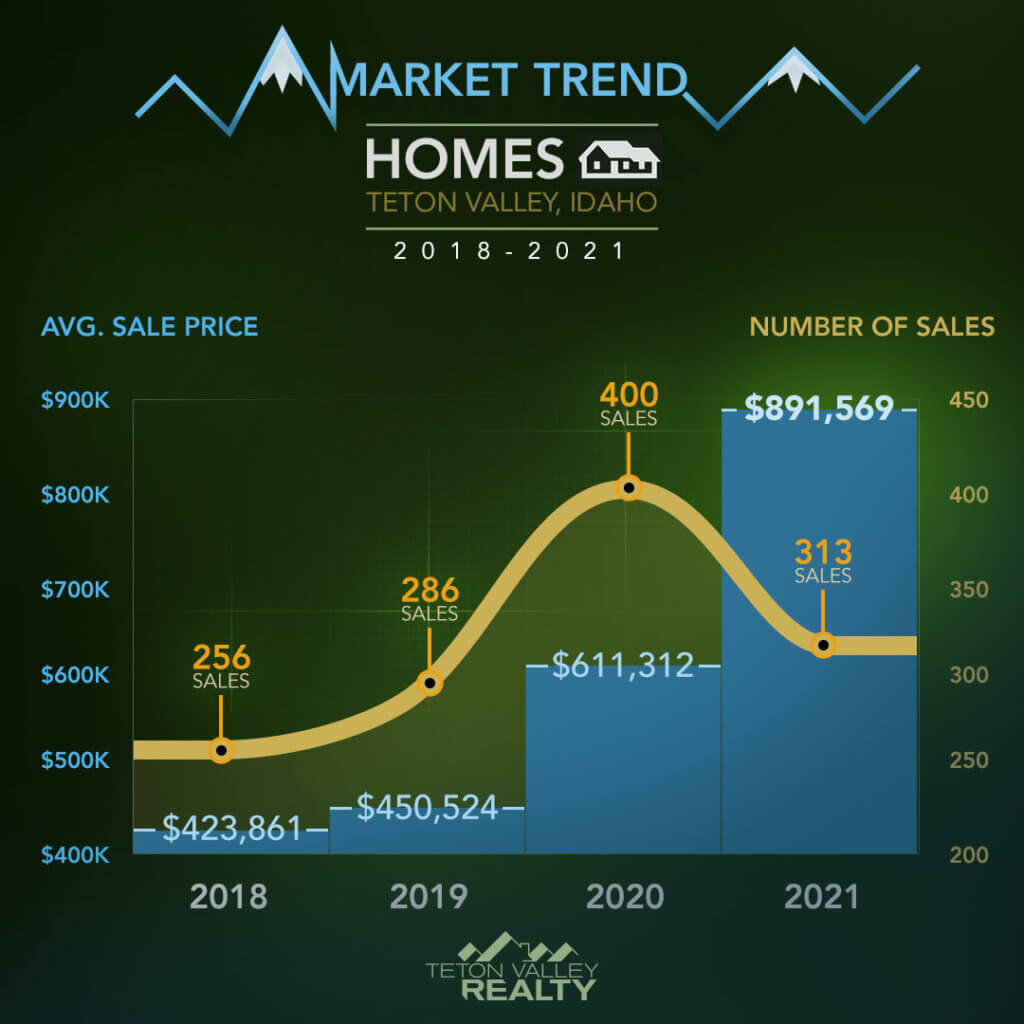
While the number of residential sales is down compared with 2020, the average sales price is a completely different story. Almost unbelievably, the average sales price in Teton Valley has more than doubled since year end of 2018, and has surged above $1m by the 3rd Q ’21.

Building Costs
Building costs have played a major role with respect to residential home prices, keeping inventory low and not giving spec home builders a confidence to meet the demand of new buyers to the area. It’s hard to quantify how much building costs have risen, but personal experience and interviewing with a few builders confirms my thoughts of somewhere in the range of 50 to 60% since 2020, somewhat consistent with the increase in the average sales price from 2020 to 2021.

2021 Year to Date
As with all market reports it’s important to look at both average sales prices as well as median sales prices that better indicate realistic numbers for middle of the road properties. A few key takeaways include the average sales price growing steadily quarter by quarter in 2021, but the median sales price reducing slightly in the fourth quarter, which is consistent with what we saw with 2021 land sales as well. Here are the numbers:

2021 Average Sales Price
Q1: 694,900
Q2: 966,655
Q3: 1,005,521
Q4: 1,093,040

2021 Median Sales Price
Q1: 558,429
Q2: 664,000
Q3: 724,950
Q4: 649,000

Predictions
This will probably sound a lot like all of those National news articles you’ve been reading, but most expect these unusual market increases as well as demand to subside back to normal rates sometime in 2022 due to supply chains catching up and interest rates increasing. With respect to our micro market, it’s hard to say when that will happen. Building costs remain high, lumber futures are again on the rise, and most builders are backlogged for the next 18 months or more. If we do see stabilization throughout the Nation, my suspicion is that it will take some time for Teton Valley to follow suit.

Marketing Backfires in a Seller’s Market

January 26, 2022 By Tayson Rockefeller Leave a Comment

Notwithstanding some recent market volatility, looming interest rate hikes and other noteworthy news headlines, supply remains incredibly low and demand is as high as ever here in Teton Valley. While the market likely won’t always be in this predicament, I believe this advice will remain pertinent for many market cycles to come.

Getting back to the subject line here, we’ve grown accustomed to allowing the market to “autocorrect” when it comes to listing properties, at least listing them too low. If we know the last sale for something was $100,000, and it was more than a couple of months ago, we usually anticipate multiple offers at or above that number. With this consideration I arrive at my first no-no;

Listing too high

This can be a delicate balance, particularly when we know that the market increases month by month. We almost have to anticipate how much it has increased but not overshoot. Overshooting typically results in “days on market”, and the general conclusion by the public is that there is something wrong with the property. Days on market can be normal in normal markets, but detrimental in hot markets.

Anticipating multiple offers

I’ve seen this one happen a few times over the past 12 months. Just because the market is hot doesn’t mean that it can’t be eclipsed by random happenings. Real estate markets always come and go in waves and cycles. It’s strange how everybody looks at real estate at the same time, and oftentimes we find that people aren’t looking at the same time. Marketing a property stating that you are “accepting offers through Tuesday at noon” when you don’t actually have an offer might deter the only person looking at the house.

Overdoing itThis one’s hand in hand with the scenario above, but overdoing it can sometimes create a marketing issue. For example, scheduling an open house with a tagline of “multiple buyers expected, showings limited between 12 to 3:00” might also detour someone that isn’t interested in bidding against multiple buyers, even when there aren’t multiple buyers. Scheduling too many open houses is also a signal that the activity was less than expected, almost as if sellers are begging for buyers, we don’t want to give that impression.

  • « Previous Page
  • 1
  • 2
  • 3
  • 4
  • 5
  • 6
  • …
  • 18
  • Next Page »

Recent Testimonials

  • Douglas V.
  • Chuck M.
  • Terry & Joy K.
Teton Valley Realty
Copyright Teton Realty Blog© 2026 - Tayson Rockefeller - [email protected] - 208-709-1333 - sitemap | Privacy Policy, Copyright & Terms of Use